When COVID-19 brought the world to a standstill, it also gave me something I had never really had before.
Time.
Like many others, I started enrolling in every online course I could find. Web development, cybersecurity, databases, networking—you name it, I was probably learning it.

The only problem?
I had no direction.
I was learning everything, but I didn’t know what I should actually master.
My father noticed something before I did.
He realised that I wasn’t simply passing time—I had genuinely fallen in love with technology. But he also knew that passion without guidance could easily become years of wandering.
So he introduced me to one of his colleagues, Mr. Kiyasudeen, who was the Chief Information Officer at Amana Bank.
That introduction changed my life.
“I Want to Become a Hacker.”
During one of our conversations, he asked me a simple question.
“What do you actually want to become?”
Without hesitation, I answered,
“A hacker… an ethical one. 🙂”
Instead of laughing it off, he listened.
He wanted to understand where I was, what I already knew, and how I thought.
Then he did something that, looking back today, shaped the rest of my career.
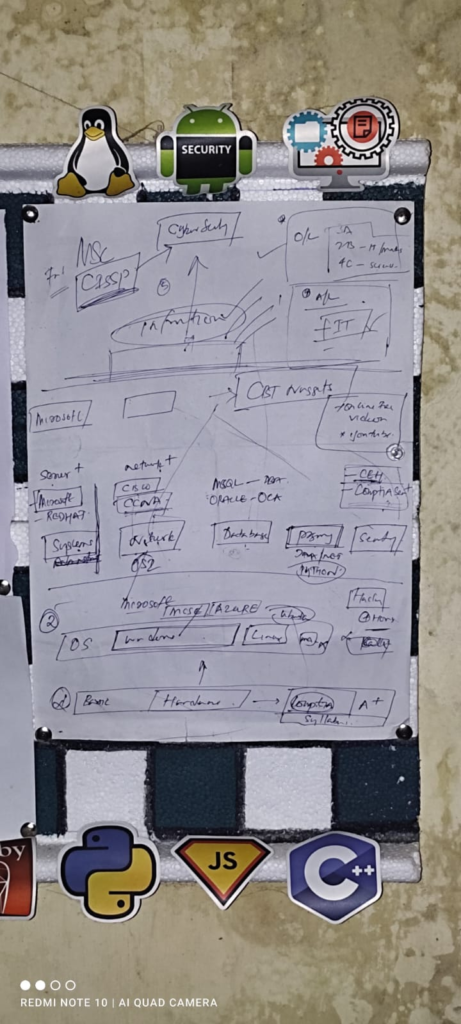
He took a piece of paper and drew a mind map.
Not a complicated one.
Just a roadmap.
A roadmap that showed me the order in which I should learn things if I truly wanted to become one of the best in the field.
That single page became my curriculum.
Learning the Fundamentals
From that day onwards, I stopped chasing random tutorials.
Instead, I started mastering the fundamentals.
I spent countless hours searching for free learning resources on Udemy, Coursera and YouTube.
I wasn’t collecting certificates.
I wanted understanding.
The first major area was computer hardware.


I immersed myself in the CompTIA A+ syllabus, learning how every component inside a computer worked—from CPUs and RAM to storage devices, motherboards and power supplies.
More importantly, I learned how to diagnose and troubleshoot problems rather than simply memorising specifications.
It completely changed how I looked at computers.


Understanding Operating Systems
The next stop on the roadmap was operating systems.
Windows.
Linux.
macOS.
Mr. Kiyasudeen recommended that I study the Microsoft Certified Systems Engineer (MCSE) syllabus because of how comprehensive it was.
There was just one problem.
Microsoft had already discontinued it.
Most people would have stopped there.

Instead, I searched everywhere until I managed to find archived training material and videos that covered the entire syllabus.
While studying Microsoft’s ecosystem, I also began learning Azure.
One of the highlights during that period was earning a voucher that allowed me to sit for Microsoft Azure certification exams in Sri Lanka—a milestone that made all those late nights feel worthwhile.
Building the Software Side
The roadmap didn’t stop with infrastructure.
I moved into software engineering fundamentals.
Databases.
Web development.
Understanding how applications were designed, built and maintained.
Little by little, the pieces started fitting together.
I wasn’t just learning technologies anymore.
I was learning how they connected.
An Unexpected Detour
Life, however, had different plans.
I received a 73% scholarship to study Software Engineering at the Java Institute for Advanced Technology.
It was an opportunity I simply couldn’t ignore.
My focus shifted.
Ironically, the months of self-learning made university much easier than I expected.
Many of the concepts my lecturers introduced were already familiar because I had spent so much time exploring them on my own.
That foundation, built from curiosity and guided by Mr. Kiyasudeen’s advice, became one of my biggest advantages.
The Call I Almost Missed

Some time later, I was teaching at Hejaaz International School.
One day, my phone rang during school hours.
I couldn’t answer.
As soon as my teaching periods ended, I called back.
It was Mr. Kiyasudeen.
He had an opportunity.
An organisation needed a web application for an upcoming event, and he wanted me to build it.
To be honest…
I was terrified.
I remember thinking,
“I’m still just a beginner. Can I really do this?”
But I accepted the challenge anyway.
I designed the system.

Built it.
Tested it.
Delivered it.
In the end, due to organisational decisions, the application wasn’t used during the event.
A manual process was chosen instead.
At first, I felt disappointed.
Had all that effort been wasted?
Not at all.
Because something incredible happened.
Despite the project never being used, I was still paid.
That moment taught me a lesson I’ll never forget.
People weren’t only paying for software.
They were placing trust in me.
Someone believed I was capable enough to solve a real-world problem.
That confidence meant more than the payment itself.
The Birth of Xyphla
After that experience, I found myself asking a different question.
Not,
“Can I build software?”
I had already answered that.
The real question became,
“If I can build solutions for one organisation… why not for many?”
That single thought slowly grew into something much bigger.
It became an idea.
Then a vision.
Then a company.
That was the beginning of Xyphla.
Looking Back
When people see the projects I’ve built today, they often assume the journey started with writing code.
It didn’t.
It started with someone taking the time to guide a curious student.
A father who recognised potential before I recognised it myself.
A mentor who drew a simple mind map instead of giving vague advice.
Countless nights of self-learning.
One phone call.
One opportunity.
One project that never even went live.
Funny enough, that “failed” project became one of the biggest successes of my career.
Because without it…
there might never have been a Xyphla.
And for that, I’ll always be grateful.